
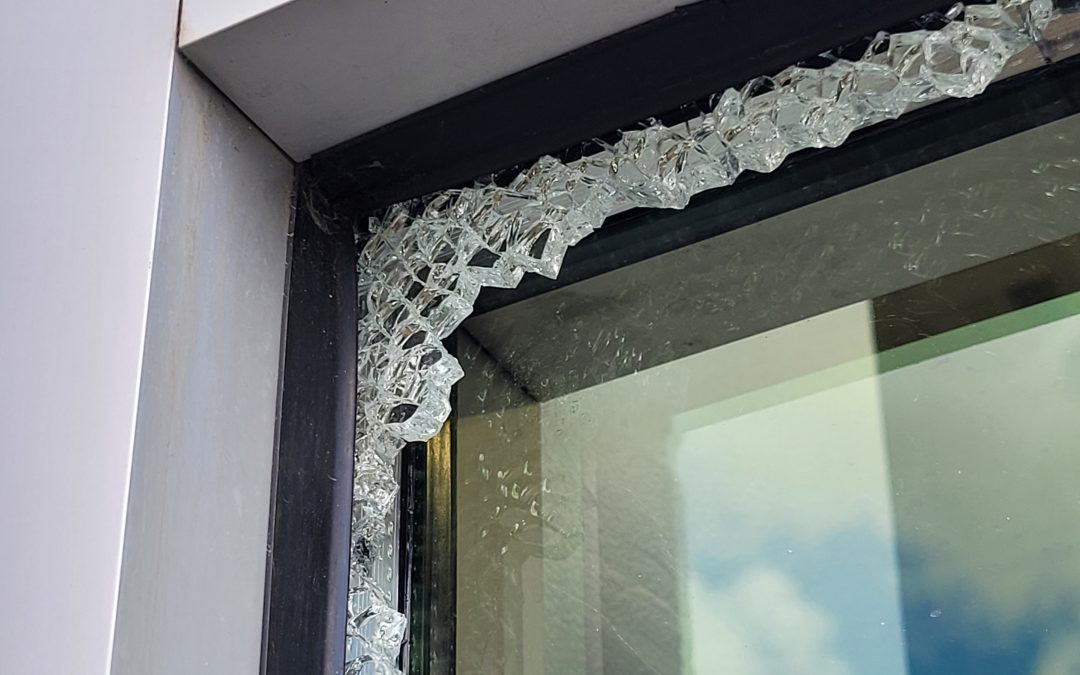
“Lawn Mower Breaks Window”… “Rock Hit Window While Mowing”
These are not the headlines you want associated with your commercial lawncare business in the newspaper, social media, or insurance claim.
When most people think about lawn care hazards, they picture flying debris, uneven terrain, or operator fatigue. What often gets overlooked—until something goes wrong—is the very real risk of mowing near windows. In commercial environments especially, this risk isn’t just theoretical. It’s a daily operational challenge with costly consequences.
From office buildings and retail storefronts to schools, hospitals, and apartment complexes, modern landscapes are designed with aesthetics and accessibility in mind. That often means large glass surfaces, low windows, and tight mowing zones. For commercial lawn care crews, these features create a perfect storm: high-powered equipment operating in close proximity to fragile—and expensive—glass.
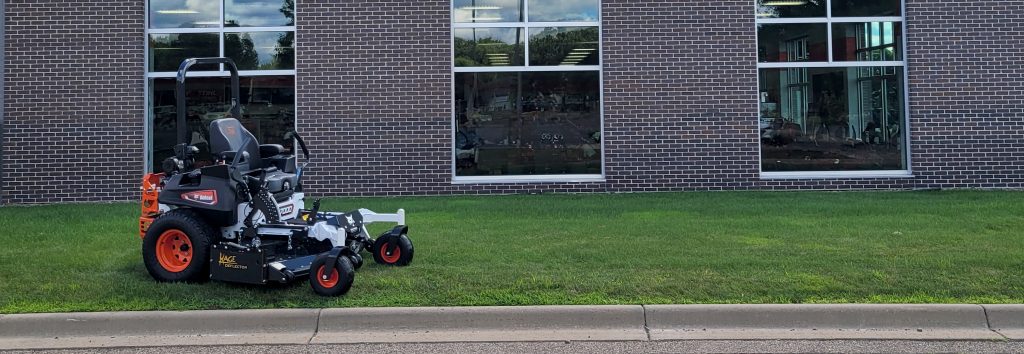
The Hidden Danger of Mowing Near Windows
Commercial mowers, particularly zero-turn mowers, are designed for efficiency and power. Their high blade speeds allow crews to cover large areas quickly, but that same power can turn small objects into dangerous projectiles. A stray rock, piece of mulch, or even a stick can be ejected at high velocity from the discharge chute.
When that chute is pointed toward a window, the result can be immediate and severe: shattered glass, property damage, potential injury to occupants, and liability claims that can quickly escalate into thousands of dollars.
Unlike open fields or residential yards, commercial properties often feature:
- Narrow mowing strips along buildings
- Landscaping beds filled with loose materials
- Curbs and hard edges that trap debris
- Windows positioned at mower discharge height
Even with the best site preparation, it’s nearly impossible to eliminate every piece of debris. That means the risk is always present.

Why Crews Can’t Always Avoid Pointing the Chute Toward Windows
A common assumption is that operators should simply avoid aiming the discharge chute toward windows. In theory, that sounds like an easy solution. In practice, it’s often not possible.
Commercial mowing is governed by efficiency, layout constraints, and safety considerations. Crews are typically working against tight schedules, covering multiple properties in a single day. Repositioning constantly to keep the chute facing away from structures can be inefficient—or even unsafe.
Here are a few real-world factors that limit positioning options:
1. Property Layout Constraints
Many commercial landscapes are designed with long, narrow strips of grass between sidewalks and buildings. In these areas, there’s often only one viable mowing direction. Turning the mower around or approaching from another angle may not be feasible due to space limitations. In some cases, both sides of the long strip have the same window hazards.
2. Obstacles and Traffic Flow
Parking lots, pedestrian pathways, signage, and landscaping features dictate how operators move through a property. Crews must often follow a specific path to avoid disrupting foot traffic or vehicle flow. That path may naturally position the discharge chute toward windows.
3. Efficiency Requirements
Time is money in commercial lawn care. Doubling back, making extra passes, or constantly adjusting direction reduces productivity. While safety should always come first, crews need tools that allow them to work efficiently without compromising protection.
4. Slope and Terrain Considerations
On sloped areas, operators must position the mower in a way that maintains stability and control. This can override ideal chute direction, especially when working near building foundations.
In short, commercial lawn care professionals don’t always have the luxury of perfect positioning. That’s why relying solely on operator awareness isn’t enough.
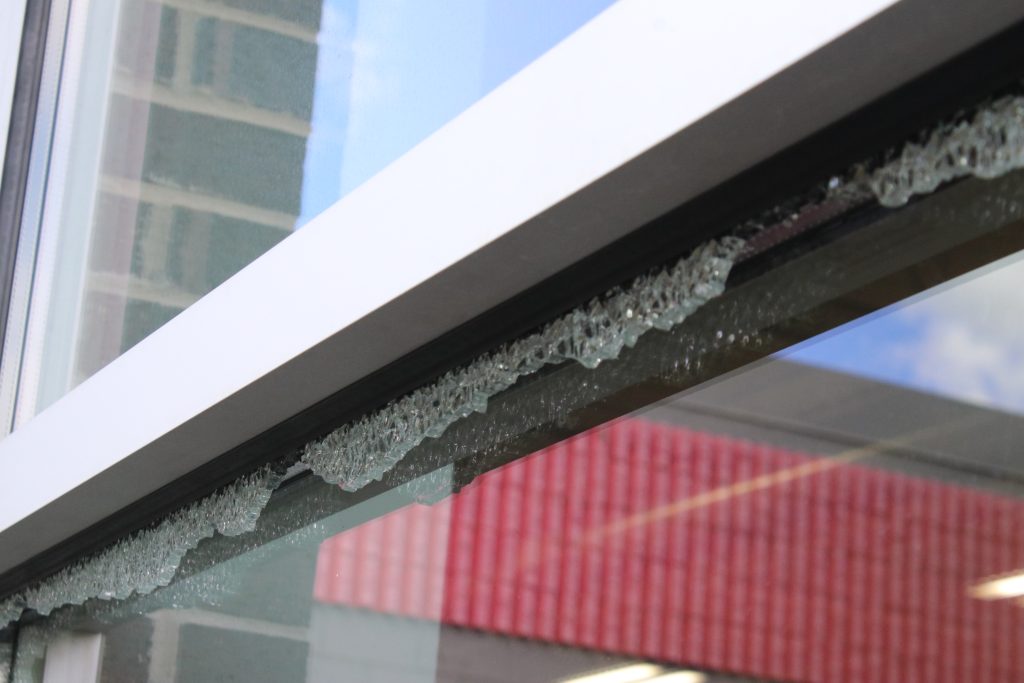
The Cost of a Single Mistake
One broken window can erase the profit from an entire job—or more. Beyond the immediate cost of glass replacement, there are additional risks:
- Liability claims if someone is injured
- Damage to reputation and client relationships
- Insurance complications and premium increases
- Downtime while incidents are investigated
For companies managing dozens or hundreds of properties, even a low probability of incidents becomes significant over time.
 The Role of a Chute Blocker
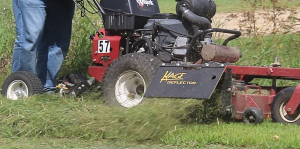
This is where chute blockers become essential. A chute blocker is a device that allows operators to temporarily stop or redirect the discharge of debris from the mower. Instead of relying on positioning alone, crews gain direct control over when and where clippings and debris are expelled.
However, not all chute blockers are created equal. In commercial settings, speed, reliability, and ease of use are critical. Operators need a solution that integrates seamlessly into their workflow—not something that slows them down or requires constant adjustment.
Why Locking Capability Matters
One of the most important features in a chute blocker is the ability to lock down securely. It’s not enough to simply deflect debris; the system must ensure that nothing escapes when the chute is closed.
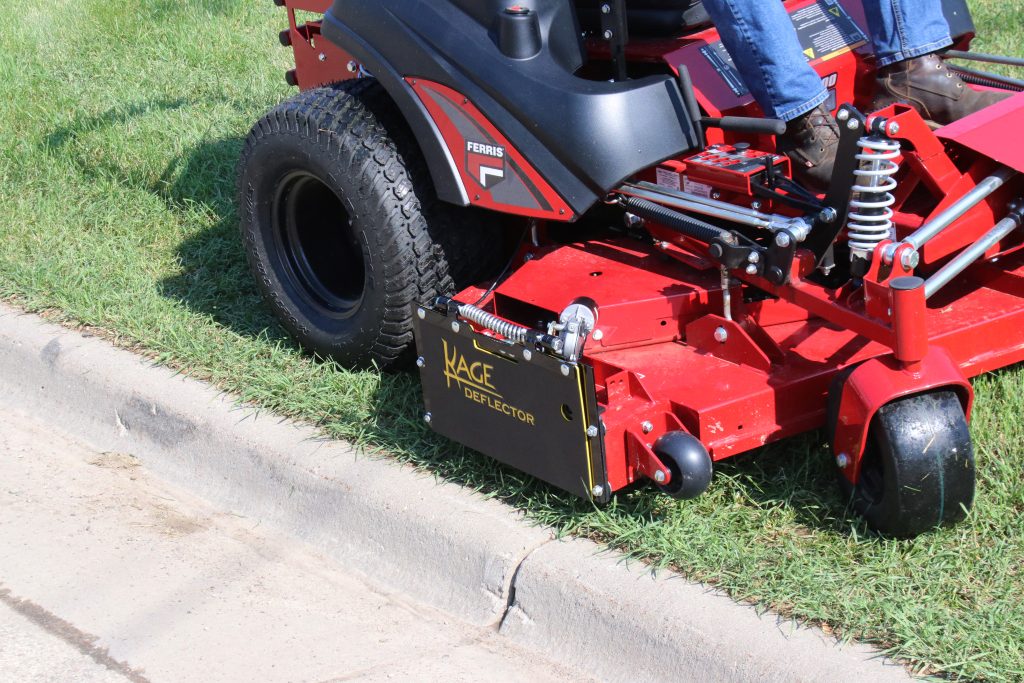
This is where a product like the KAGE Deflector stands out. Its torsion spring mechanism allows the deflector to lock down tightly over the discharge opening. This creates a solid barrier that prevents projectiles from being ejected toward sensitive areas like windows.
The torsion spring provides consistent pressure, ensuring that the deflector stays in place even under the force of high-speed blade rotation. This level of security is crucial when operating near glass, vehicles, or pedestrian zones.
Speed and Ease of Use in Real-World Conditions
Equally important is how quickly and easily the operator can engage the chute blocker. Commercial mowing is fast-paced. Crews don’t have time for complicated adjustments or manual interventions that require stopping the machine.
The KAGE Deflector is designed with this reality in mind. Operators can engage or disengage it quickly, with nothing more than a toggle switch. This means they can respond instantly when approaching a hazard zone—like a row of windows—and then resume normal or directional discharge once they’ve passed it.
This seamless operation encourages consistent use. If a safety tool is cumbersome, it won’t be used as often as it should be. But when it’s intuitive and efficient, it becomes a natural part of the mowing process.
A Smarter Approach to Risk Management
Ultimately, mowing near windows is a risk that can’t be eliminated—but it can be managed effectively. The key is combining operator awareness with the right equipment.
Best practices include:
- Inspecting the mowing area for debris before starting
- Being mindful of chute direction whenever possible
- Slowing down in high-risk zones
- Using a reliable chute blocker when near windows or other hazards
By adding a high-quality chute blocker like the KAGE Deflector into the equation, commercial lawn care providers gain an extra layer of protection. It’s not just about preventing damage—it’s about working smarter, safer, and more confidently in environments where precision matters.
In commercial lawn care, the smallest oversight can lead to significant consequences. Windows, while seemingly passive elements of a landscape, represent one of the most vulnerable—and costly—hazards crews face.
Because operators can’t always control their positioning, they need tools that give them control over the outcome. A chute blocker with a secure locking mechanism and quick, easy operation isn’t just a convenience—it’s a necessity.
Investing in the right equipment doesn’t just protect property. It protects your business, your reputation, and your bottom line.
Recent Comments