
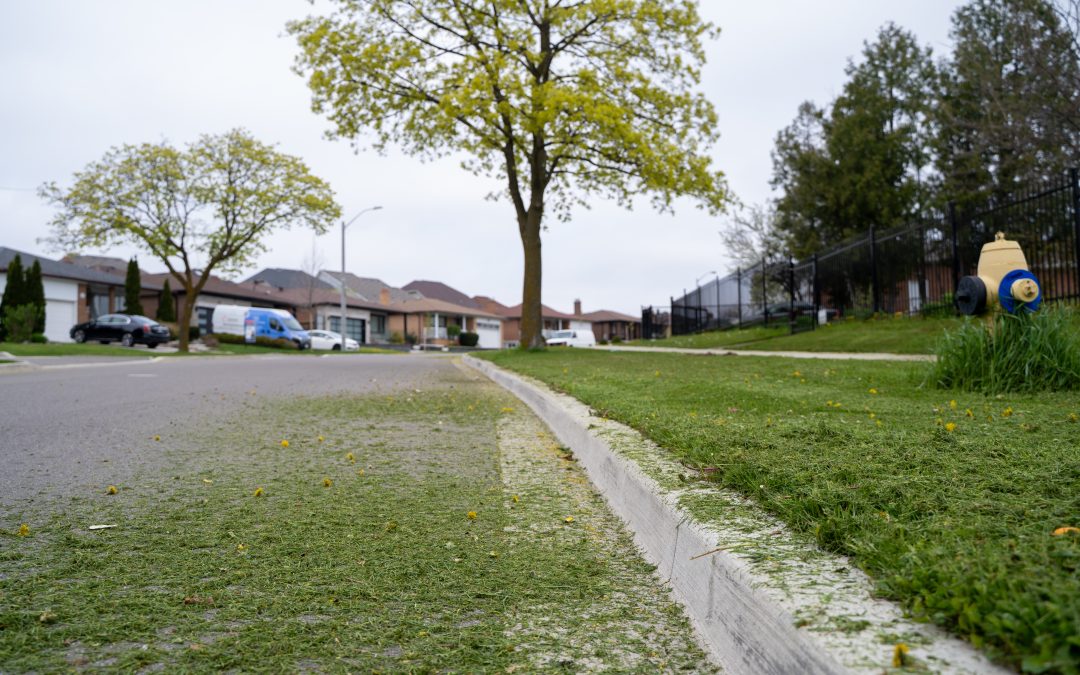
For professional lawn care crews, mowing along a street can look like one of the simplest parts of a property. The terrain is often open, the mowing line is easy to see, and there may be few obstacles in the turf itself.
But the edge of a roadway creates a different challenge: where does everything coming out of the mower deck go?
Grass clippings are only part of the concern. A mower can encounter sticks, gravel, rocks, and other debris hidden in the turf. When the discharge chute is pointed toward a street, that material can potentially be thrown toward passing vehicles, bicyclists, motorcycles, pedestrians, or parked cars.
Even when the mower is only throwing grass, allowing clippings to accumulate on the roadway can create additional cleanup, environmental concerns, and—in some communities—potential ordinance violations.
For commercial mowing contractors and property maintenance crews, controlling discharge before it reaches the street can be a better approach than cleaning up the problem afterward.
The Challenge of Mowing Along a Road
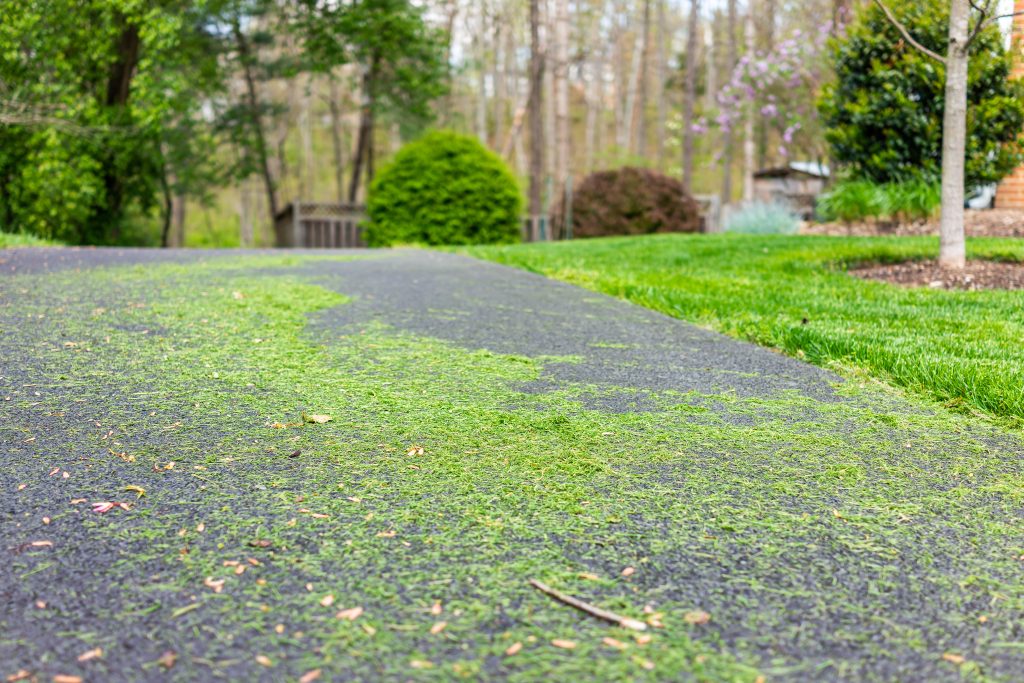
Traditional side-discharge mowers work well when there is plenty of open turf available for dispersing clippings. Roadsides are different.
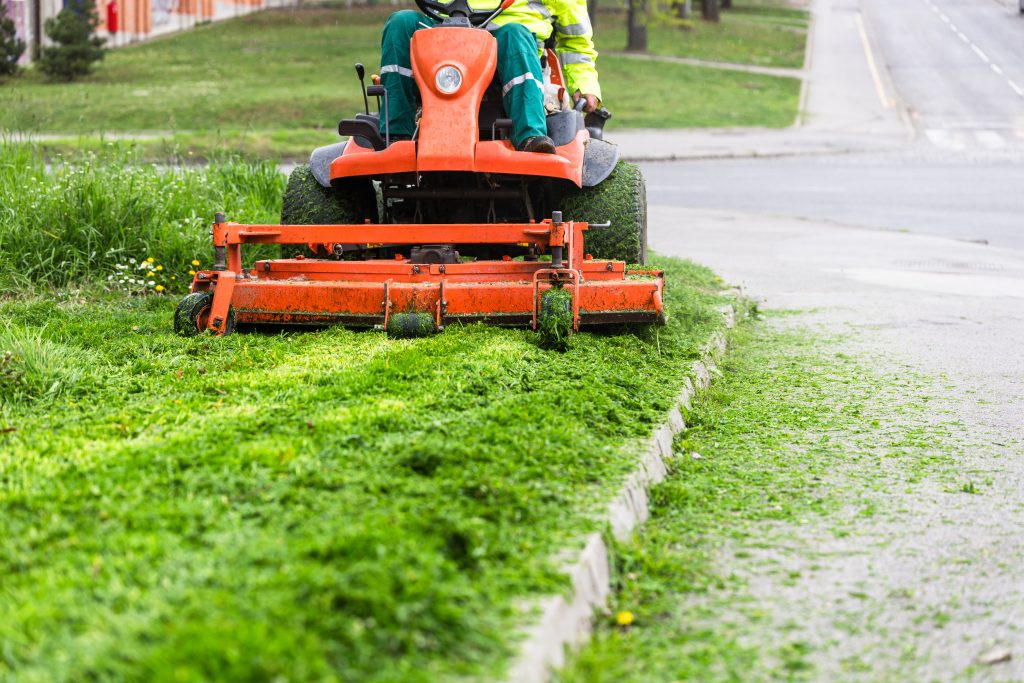
Depending on the mowing direction, the discharge side of the deck may face directly toward the pavement. That forces the operator to make a choice: change the mowing pattern, accept that material may be discharged toward the street, or find another way to control the mower’s discharge.
Changing the mowing pattern isn’t always convenient. Trees, signs, ditches, sidewalks, curbs, landscaping, slopes, and property boundaries may limit the operator’s options.
That is why discharge control can be particularly valuable when mowing road frontage.
Grass in the Street Can Be More Than an Appearance Problem
Leaving grass clippings on pavement isn’t simply a question of whether a property looks professionally maintained.
Some municipalities specifically prohibit blowing, mowing, or depositing grass clippings into public streets.
For example, Milwaukee states that moving or blowing grass clippings into the street violates city ordinance. The Village of Belmont, Wisconsin, prohibits depositing, placing, or mowing grass clippings and other yard waste onto public streets, roads, alleys, or highways and lists forfeitures for violations. Omro, Wisconsin, similarly prohibits grass clippings from being allowed to blow onto or accumulate on public streets where they could wash into storm sewer inlets.
These rules vary considerably by municipality and state, so contractors should always check the requirements that apply where they work. But the examples illustrate an important point: keeping clippings out of the street may be a compliance issue, not merely a matter of appearance.
There can also be environmental reasons behind these ordinances. La Crosse, Wisconsin, prohibits intentionally placing grass clippings and other organic material in streets and gutters and identifies grass and leaves among prohibited storm-sewer discharges. Chilton notes that clippings can clog storm sewers and contribute to degradation of local water quality; the city instructs operators mowing next to streets to direct mower discharge toward the yard and requires street clippings to be removed when they cannot be avoided.
Roadway safety is another concern. Eau Claire specifically warns residents not to mow or blow grass into streets, noting both stormwater impacts and hazards for drivers, particularly motorcycles and bicycles.
For a professional contractor, that creates several good reasons to manage discharge at the mower rather than after the fact.
The Hidden Cost: Cleaning the Street After You Mow
Even where there is no applicable ordinance, grass covering the roadway doesn’t exactly say, “professional job complete.”
Someone has to clean it up.
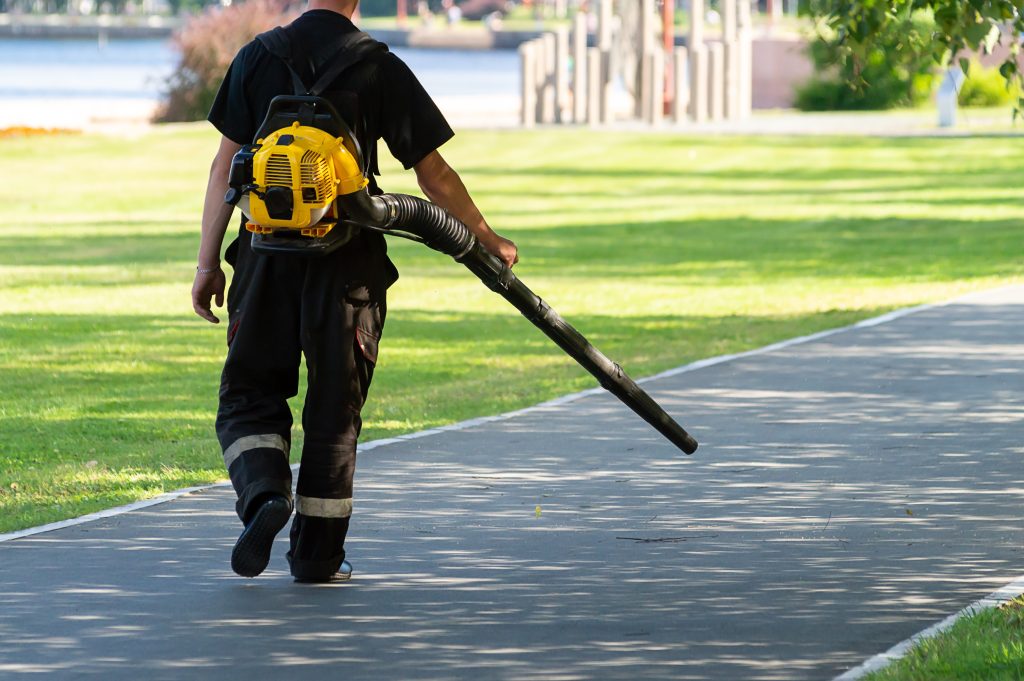
That often means finishing the mowing, grabbing a backpack blower, walking the road frontage, and blowing the clippings back onto the turf. Depending on the property, the operator may also need to clean sidewalks, gutters, curbs, and driveways.
The important productivity measurement isn’t simply how fast the mower cuts the lawn. It’s how long the crew spends on the property from arrival until the job is completely finished.
Consider a hypothetical commercial mowing route with 15 properties. If unnecessary street cleanup takes just four minutes per property, that’s 60 minutes of labor over the route.
Do that once per week for a 30-week mowing season and it becomes 30 hours of labor spent cleaning up something that might have been prevented during mowing.
Actual savings will vary by property, mowing conditions, crew, and equipment, but the principle is simple:
The fastest cleanup may be the cleanup you never have to perform.
KAGE’s own commercial mowing materials make the same productivity point: controlling discharge at the mower can reduce corrective blower work after mowing, and small time savings can become significant when multiplied across a commercial route.

Option 1: Control the Discharge with the KAGE Grass Deflector
When you want to keep side-discharging but need more control around the roadway, the KAGE Grass Deflector provides an operator-controlled solution.
The electrically-powered chute blocker allows the operator to adjust the deflector using a conveniently positioned magnetic toggle switch. Instead of having only an open side-discharge chute, the operator can change the flap position to control how material leaves the deck. With up to 260 degrees of infinitely-adjustable flap pivot, the Grass Deflector can change the angle of discharge or block it completely.
That flexibility can be especially useful when mowing parallel to a roadway.
On open turf, the operator can allow normal discharge. When the mower approaches a street, driveway, vehicle, landscape bed, sidewalk, or another sensitive area, the operator can adjust the deflector to better contain or redirect discharge. Once the sensitive area has been passed, the operator can return to the desired discharge position.
The Grass Deflector also incorporates a breakaway torsion spring designed to let the flap give when it contacts an immovable obstacle and to maintain pressure when the chute is closed.
For a commercial operator, the advantage is straightforward: more control without continually stopping the mowing operation to manually reposition a discharge chute.
Controllable discharge can give operators more flexibility around sidewalks, landscaping, buildings, and other boundaries instead of forcing the entire mowing pattern to accommodate a fixed discharge direction.

Option 2: Collect the Clippings with the KAGE Katcher
There are other situations where redirecting the clippings isn’t enough.
Sometimes you don’t want the clippings discharged at all.
That’s where the KAGE Katcher provides another option.
The KAGE Katcher mounts to the mower’s side discharge and collects grass and leaves in a 5.8-cubic-foot basket. Rather than requiring the operator to remove and manually dump the catcher each time it fills, the Katcher uses an electric actuator controlled by a toggle switch. The operator can dump the basket without leaving the operating position.
The catcher can also transition between collection and dispersion without being removed from the mower.
For roadside mowing, collection can be useful when the objective is to keep clippings contained rather than simply redirecting them. Instead of mowing first and then returning with a blower to remove grass from the street, the operator can collect material as the turf is being cut.
That can be especially useful around:
- High-traffic roads
- Parking lots
- Curbs and gutters
- Commercial entrances
- Sidewalks
- Highly maintained properties
- Areas where clipping accumulation is undesirable
- Locations where local rules restrict grass from entering streets or stormwater systems
The Katcher’s angled design is also intended to provide clearance when working around ditches and slopes—terrain frequently encountered along roadsides.
Deflect or Collect: Two Ways to Solve the Same Problem
Not every roadside mowing job needs a grass catcher, and not every situation can be handled simply by changing the direction of discharge.
That’s why the Grass Deflector and KAGE Katcher provide two different approaches.
Use the KAGE Grass Deflector when you want to continue dispersing clippings but need greater control over where they’re going.
Use the KAGE Katcher when you want to collect and contain the material instead.
Together, they give commercial mowing professionals options for adapting to different properties rather than using the same discharge strategy everywhere.
Productivity Is About Finishing the Entire Job Faster
Mowing productivity is often discussed in terms of mower speed, deck width, and acres per hour. Those measurements matter, but they don’t tell the entire story.
If a mower finishes cutting quickly but the crew spends another 10 or 15 minutes blowing streets, sidewalks, parking areas, and landscaping, that cleanup is still part of the cost of servicing the property.
Preventing clippings from reaching those areas in the first place can eliminate an entire step from the workflow.
Over one lawn, the difference might only be a few minutes.
Across 10, 20, or 30 stops in a commercial route, those minutes can become hours. Across an entire mowing season, they can represent a meaningful amount of labor.
And when the area being protected is a public roadway, there may be additional benefits: cleaner storm drains, reduced roadway debris, a more professional finished property, and better compliance with local requirements.
Control the Clippings Before They Become Cleanup
The best solution to grass clippings in the street isn’t always a bigger backpack blower.
Sometimes it’s keeping the grass out of the street in the first place.
The KAGE Grass Deflector gives operators the ability to control mower discharge as conditions change. The KAGE Katcher provides the option to collect clippings when containment is the better solution.
For professional mowing crews working around streets, sidewalks, parking lots, landscaping, and other sensitive areas, both attachments address the same fundamental challenge:
Control where the material goes while you’re mowing—so you spend less time dealing with where it went afterward.
Local laws and ordinances vary. The examples above are provided for general informational purposes and are not legal advice. Lawn care professionals and property owners should verify applicable municipal, county, and state requirements before operating equipment or disposing of yard waste.
Recent Comments