

Dust can quickly become a problem on gravel roads, driveways, parking lots, construction sites and other unpaved surfaces. Every passing vehicle can send fine particles into the air, reducing visibility, creating a mess and gradually removing valuable fines from the road surface.
A dust control water sprayer provides a straightforward solution by applying water or a dust suppressant to the surface. But when longer-lasting dust control is needed, brine can offer an advantage over water alone.
So, how does dust suppression brine work, and what equipment do you need to apply it effectively?
How Does Brine Suppress Dust?
Dust suppression brines are liquid solutions containing salts such as calcium chloride or magnesium chloride. When applied to gravel or dirt surfaces, these solutions help keep fine particles moist and prevent them from becoming airborne.
The process starts when the brine is sprayed across the road or other dusty surface. The water immediately wets the fine material, while the dissolved chloride remains behind as the surface begins to dry.
Calcium chloride and magnesium chloride are hygroscopic, meaning they attract and retain moisture. Instead of allowing the road surface to dry as quickly as it would after an application of plain water, the chloride helps the fine material retain moisture.
That moisture is important because damp fines tend to adhere to one another and to larger pieces of aggregate. When vehicles travel across the surface, fewer loose particles are available to become airborne.
In simple terms:
Apply brine → wet the road fines → retain moisture → bind fine particles → reduce airborne dust.
Brine vs. Water for Dust Control
Water is one of the simplest methods of dust suppression. A dust control water sprayer can quickly wet a gravel road, parking lot or work site and provide immediate relief from airborne dust.
The limitation is evaporation.
As the water evaporates, the surface dries and dust can return. During hot, dry or windy weather, this can happen relatively quickly and require repeated applications.
Brine works differently because the dissolved salts remain on and within the treated surface after some of the original water evaporates. Those salts help retain moisture and, under appropriate conditions, can attract moisture from the surrounding environment.
This can extend the useful dust-control period compared with water alone.
However, brine isn’t permanent. Heavy rainfall can dilute or wash chloride away, extremely dry conditions can reduce its effectiveness, and excessive application should be avoided. Operators should always follow applicable product instructions and environmental requirements when selecting and applying a dust suppressant.
Why Application Equipment Matters
Whether you’re applying plain water or a chloride-based dust suppressant, uniform coverage matters.
Applying too little liquid may leave portions of the road untreated. Applying too much can waste material and potentially create an overly wet or slippery surface.
For larger gravel roads, driveways and parking areas, repeatedly applying liquid with a small sprayer can also become inefficient. Tank capacity, spray width and the ability to carry the sprayer with equipment already in your fleet can all influence productivity.
That’s where a purpose-built dust control water sprayer can make a difference.
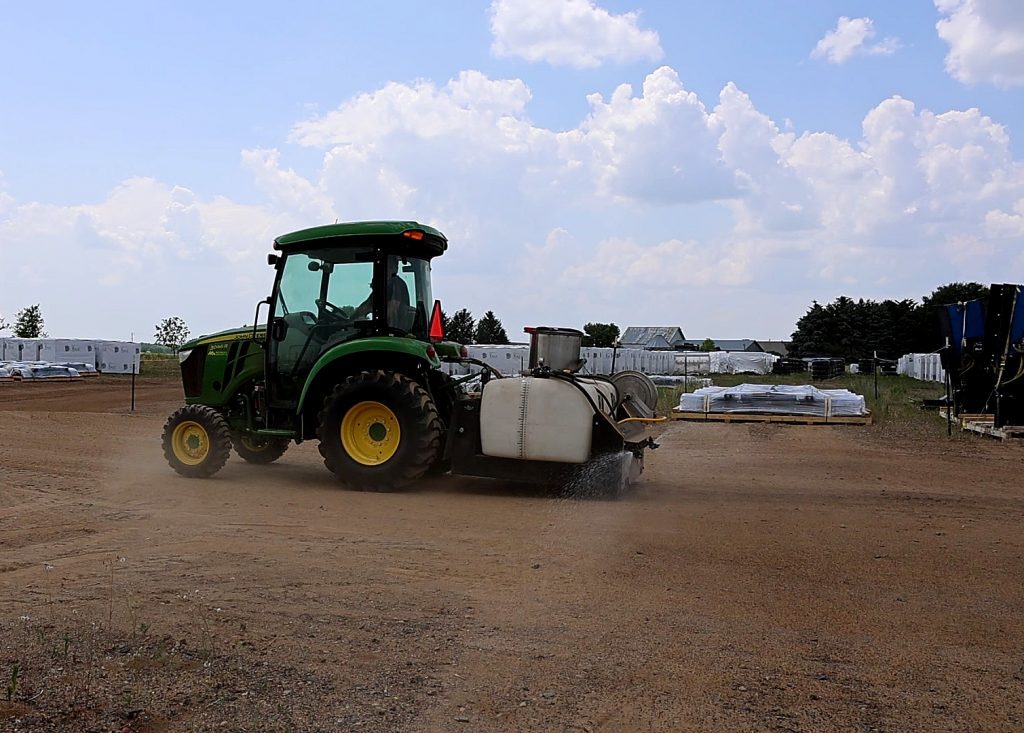
Using the KAGE LiquidRage for Dust Suppression
The KAGE LiquidRage is a boomless liquid sprayer designed for applications including dust suppression. It can apply water as well as appropriate dust-control liquids, giving operators the flexibility to choose a treatment based on the conditions and application.
One of its biggest advantages for dust-control work is its 150 gallon sprayer tank.
 Why a 150 Gallon Sprayer Tank Matters
Tank capacity directly affects how frequently an operator has to stop and refill.
A small tank may be adequate for spot treatment, but covering roads, large gravel parking lots or other expansive areas can consume substantial amounts of liquid. Every trip back to the water source means additional time that isn’t being spent spraying.
The LiquidRage’s 150-gallon sprayer tank gives operators more capacity for these larger applications. KAGE designed the unit to carry up to 150 gallons while remaining adaptable to compact equipment used for property and grounds maintenance.
For crews looking for a dust control water sprayer, that capacity can mean longer operating periods between fill-ups and fewer interruptions during larger jobs.
Operators do need to account for all that liquid weight. Not every wheel loader or other carrier can safely handle the LiquidRage when its 150 gallon sprayer tank is completely full. The tank should only be filled to a level that stays within the rated capabilities of the carrier machine.
Cover Up to a 30-Foot Swath
Capacity isn’t the only factor affecting dust-control productivity. Spray coverage matters too.
When equipped with its broadcast nozzle kit, the LiquidRage can cover swaths up to 30 feet wide, allowing an operator to treat a substantial portion of a gravel surface with each pass. KAGE’s broadcast nozzles are particularly useful for dust-suppression applications.
For large parking areas, wide gravel roads and similar properties, combining broad coverage with a 150 gallon sprayer tank can reduce unnecessary passes and refill stops.
When more targeted application is needed, an optional 50-foot hose reel and spray wand can be used for areas where broad broadcast coverage isn’t appropriate.
 One Sprayer for Multiple Carrier Machines
Another consideration when choosing a dust control water sprayer is how it fits into an existing equipment fleet.
The LiquidRage uses KAGE’s attachment system designed to work with skid-steer-style mounting and a CAT II 3-point hitch. KAGE also designed the sprayer for use with compatible utility vehicles and other equipment, depending on the carrier’s capacity.
That versatility allows a grounds maintenance crew, municipality, contractor or property owner to use equipment they may already have rather than maintaining a dedicated dust-control vehicle.
 Water or Brine? Choose the Right Dust Suppressant for the Job
There isn’t one dust-control liquid that’s ideal for every application.
Plain water can make sense when immediate, temporary dust suppression is the goal and frequent reapplication isn’t a problem. It is simple and doesn’t leave chloride behind.
Brine or other approved dust-control agents can make sense when longer-lasting moisture retention is desired. Calcium chloride and magnesium chloride solutions can help keep fine material damp for longer periods, reducing how easily traffic and wind can lift those particles from the surface.
Whichever treatment is selected, a capable dust control water sprayer helps distribute the liquid consistently across the area being treated.
 More Than a Dust Control Water Sprayer
Dust suppression is also only one use for the LiquidRage.
The same 150 gallon sprayer tank can support several seasonal liquid-application jobs. KAGE designed the LiquidRage for applications including dust suppression, herbicides and insecticides during warmer months and brine application for ice prevention operations during winter.
Optional equipment includes broadcast nozzles, a hose reel and spray wand, and a brine mixer that mounts to the sprayer.
That gives contractors, municipalities and grounds-maintenance operations an opportunity to use the same sprayer throughout multiple seasons rather than purchasing equipment for just one application.
Control Dust and Keep Gravel Surfaces in Better Condition
Effective dust suppression isn’t simply about knocking dust out of the air. Keeping fine material in the road surface can help maintain the mixture of fines and larger aggregate that makes up a gravel road, driveway or parking area.
Water provides immediate dust suppression, while chloride brines can help retain moisture and keep those fine particles bound together longer.
For operators who need to cover substantial areas, the KAGE LiquidRage combines a 150 gallon sprayer tank, boomless spraying and available broadcast coverage up to 30 feet wide in a versatile dust control water sprayer designed to work with multiple types of compact equipment.
Whether you’re maintaining gravel roads, driveways, parking lots or other dusty surfaces, matching the right dust suppressant with the right application equipment can mean fewer airborne particles, more efficient application and a cleaner working environment.
Learn more about the KAGE LiquidRage and how a 150 gallon sprayer tank can help make your next dust-control job more efficient.
Recent Comments